Why We Replaced Written Dailies with Weekly Outcome Commitments
Written dailies repeat the board and nobody reads them. We replaced them with one outcome a week, a confidence check on Wednesday and a close-out on Friday.

Founder of FlowBoard · Full-stack developer & serial entrepreneur
The daily nobody read
Our team ran a Monday kickoff and then wrote dailies, Tuesday to Friday, in a Slack channel. Three lines each: what I did, what I will do, what is in the way. It is the standard async standup and it is recommended everywhere.
Here is what happens to them. The updates get shorter. Then they get templated. Then they get posted late as a formality, and when someone stops, nobody notices. That is what told us nobody was reading them, me included. I was reading the board, because the board already had the same information, more accurately, with timestamps.
This is the documented failure mode of async standups. A written update only survives while someone is obliged to consume it. Remove the reader and the writers notice within weeks, and the ritual dies quietly, without anyone deciding to kill it.
The board already knows what you did
A daily is a second copy of the task board, typed by hand and out of date by lunch. Every task has a status, an assignee, a history and a comment thread. "Yesterday I worked on the export" adds nothing that "#212, in progress since Tuesday" does not already say better.
So the honest question was not "how do we make people write better dailies". It was: what does the board not know? And the answer is narrow. The board cannot tell you whether a person will deliver the thing they said they would this week. Status is not confidence. A task can sit at "in progress" for three days while its owner already knows it will slip, and nothing on the board changes until Friday.
That one question, will you make it, is the only thing worth asking a person that a tool cannot answer. So we built the ritual around it and dropped everything else.
What replaced it
Three touchpoints a week. Two of them are automatic.
- Monday, in the kickoff we already had. Each person declares one or two commitments for the week. Not tasks. Outcomes: by Friday, who will be able to do what that they cannot today. "Finance can export last month's invoices themselves." "QA can run the whole support flow in the app." The person proposes them, and everyone can see everyone's.
- Wednesday 09:00, automatic. Each person gets one message per commitment with three buttons: on track, at risk, blocked. Green is one click. Yellow and red ask for one line on what is in the way. At 12:00 the manager gets a summary, at risk and blocked first.
- Friday 16:00, automatic. Met or not met, per commitment. At 18:00 the manager gets the completion ratio, the carry-overs and the trend.
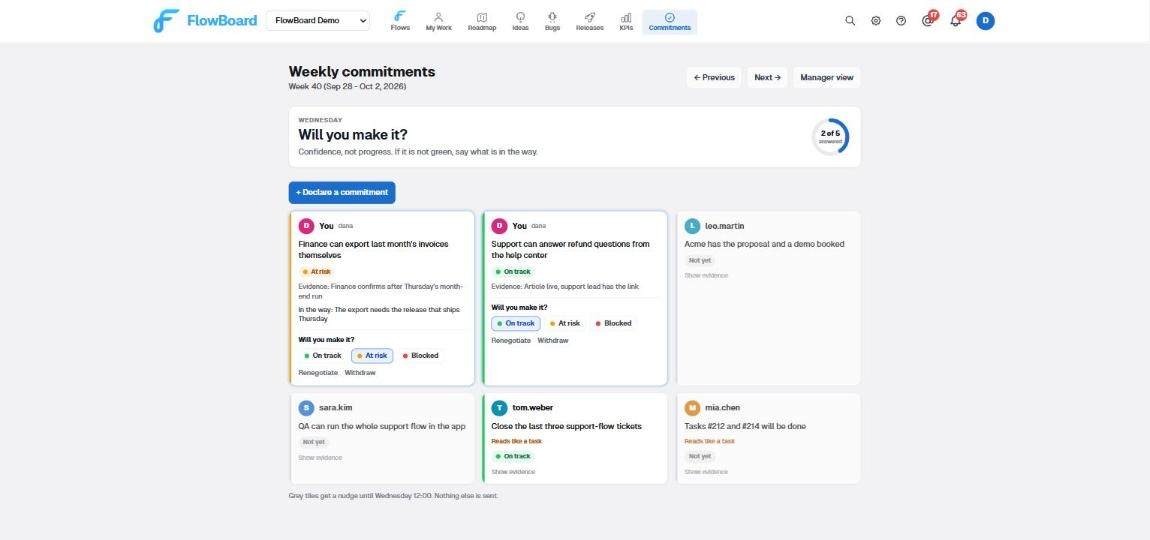
That is the whole ritual. Nobody writes free text unless they are declaring a blocker or changing a commitment. Nobody has to remember anything, because every input arrives as a message with a link to the exact form, and it comes back until answered.
Flow, not sprints
We run continuous flow, not sprints, so the obvious objection is that we reinvented the sprint commitment with a shorter name. We did not, and the difference matters.
A sprint commitment is a batch: the team commits to a list of tickets and the unit of accountability is the list. A weekly outcome commitment is personal and singular: one person, one result, one recipient. The board keeps flowing underneath it. Tasks still get pulled in priority order, work still ships when it is ready, and nothing waits for a ceremony. The commitment is a promise on top of the flow, not a container around it.
It also has no planning overhead. There is no estimation session, no capacity spreadsheet, no carry-over negotiation. You say what will be true on Friday. On Friday it is true or it is not.
Outcomes, not task lists
This is the rule we got wrong first and fixed fastest. In our first live week, one of the juniors declared "Tasks #212 and #214 will be done". Perfectly honest, and useless. Both tasks were already on the board with an assignee and a status. The declaration told us nothing we did not have, and it gave the person nothing to aim at except closing tickets.
An outcome names someone else. "Support can answer refund questions from the help center" tells you who benefits, what changes for them, and how you would check. It survives the discovery that the two tickets were not actually enough. It also lets the person renegotiate the work under it freely, because the promise was never the tickets.
The question we now ask on Monday is literally "By Friday, who will be able to do what that they cannot today?", with an example drawn from the person's own role. If the text still reads like a task list, the form says so and offers to keep it anyway. Managers see a small "reads like a task" mark on the wall and rewrite it together on Monday. Nothing is blocked. The nudge is enough.
Confidence, not progress
The Wednesday question is "will you make it?", and it is never "what did you do?". This is not a tone preference. The moment a mid-week check-in becomes a status report to the boss, people start writing for the reader instead of saying whether they will make it, and that is exactly why teams come to hate these rituals.
Three buttons make the honest answer the cheapest one. Green costs one click and nothing to write. Yellow and red cost one line, and the only line the manager can act on: what is in the way. There is no percentage complete, no "on track but" paragraph, no place to perform.
The rules we would not trade
- Renegotiation is visible and always available. A commitment can be changed or withdrawn any day before the close-out, with a reason, in front of the team. A withdrawn commitment counts neither as met nor as not met. Without this you do not get honesty, you get silent failure on Friday.
- Healthy completion is around 90%. A team at 100% every week is not excellent, it is committing to less than it can. Four weeks in a row at 100% gets flagged as "committing below capacity". A drop under 70% two weeks running gets flagged too.
- The same commitment cannot run more than two weeks. If it is still not done after two weeks it is either too big to be a commitment or not important enough to be one. Either way it needs reshaping, not a third carry-over.
- Calls are rotation, not punishment. The Wednesday summary suggests one or two people to call, least recently called first, even when everything is green. That way a call from the manager is just a call.
- Nothing waits on memory. Prompts, reminders and escalation to the manager after the second reminder are automatic. The ritual survives a busy week without anyone chasing.
What the first live week taught us
We shipped this in FlowBoard and turned it on for our own team the same week. Three things changed within days.
The original form asked for a recipient and a satisfaction criterion as two separate fields, and people answered the second by repeating the first in other words. We replaced the criterion with "Who will notice, and how?" answered with a chip: a person, a link, a number, a board task. It is optional and skippable. Evidence is now something that exists on Friday, not the outcome rephrased.
We also dropped the due day. The week is the deadline. Asking for a day inside the week added a decision with no consequence and made every commitment look like a task with a date.
And the first Wednesday, the manager reminder read exactly like the owner's prompt, so I got "Reminder 2" twice and thought the system was broken. It was two escalations for two reports who had not declared. The manager copy now says who has not declared, and asks for a word with them rather than an answer.
Should you do this?
If your team writes dailies and you can name the last one you read, keep them. If you cannot, you are already running on the board and the dailies are theatre. Replace them with one promise a week that someone else can verify, ask for confidence on Wednesday, and read the numbers on Friday.
You can run this with a channel and a calendar. If you want the prompts, the reminders and the summaries to happen on their own, weekly commitments are built into FlowBoard, and there is a free copy-paste version that needs no account at all. For the day-by-day, read one week with weekly commitments.
Built for Small Teams That Ship
No Scrum Master needed. FlowBoard gives lean teams the structure they need without the overhead they hate.
Try It FreeKeep reading
Weekly Commitments in FlowBoard: Slack Prompts, Manager Escalation and the Friday Completion Ratio
FlowBoard now runs the weekly commitment ritual for you: Slack prompts with buttons, reminders that escalate to the manager, and two summaries a week.
TutorialOne Week with Weekly Commitments: Monday to Friday, Step by Step
A day-by-day walkthrough of weekly commitments in FlowBoard: the Monday declaration, the Wednesday check-in and summary, and the Friday close-out.
ProductivityThe Meeting Tax: Why Status Updates Cost More Than You Think (And What to Do Instead)
Status meetings cost a team 800+ hours a year. The real math behind meeting overhead, why async works better, and a 5-minute check-in for when you need one.
CommunicationAsynchronous Communication in Project Management: Tools and Best Practices
How async communication cuts meetings and improves output. Tools and practices for running project work across time zones without constant real-time calls.